

How To Draw Ionic Lewis Structures
Learning Objective
- Apply the rules for drawing Lewis structures to polyatomic ions
Central Points
- Ions are treated virtually the aforementioned style as a molecule with no charge. Still, the number of electrons must exist adjusted to business relationship for the net electrical charge of the ion.
- When counting electrons, negative ions should have extra electrons placed in their Lewis structures, while positive ions should take fewer electrons than an uncharged molecule.
Term
- polyatomic ionA charged species composed of ii or more atoms covalently bonded, or of a metal circuitous that acts as a unmarried unit of measurement in acid-base chemistry or in the formation of salts. Also known every bit a molecular ion.
The full number of electrons represented in a Lewis structure is equal to the sum of the numbers of valence electrons in each private atom. Non-valence electrons are not represented in Lewis structures. After the total number of available electrons has been determined, electrons must be placed into the construction.
Lewis structures for polyatomic ions are drawn past the same methods that nosotros have already learned. When counting electrons, negative ions should accept actress electrons placed in their Lewis structures; positive ions should accept fewer electrons than an uncharged molecule. When the Lewis structure of an ion is written, the unabridged structure is placed in brackets, and the charge is written equally a superscript on the upper right, outside of the brackets. For example, consider the ammonium ion, NH4 +, which contains 9 (five from N and 1 from each of the four H atoms) –i = 8 electrons. One electron is subtracted because the unabridged molecule has a +1 accuse.

Negative ions follow the same procedure. The chlorite ion, ClO2 –, contains 19 (seven from the Cl and 6 from each of the 2 O atoms) +1 = 20 electrons. 1 electron is added because the entire molecule has a -1 charge.
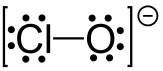

Source: https://courses.lumenlearning.com/introchem/chapter/lewis-structures-for-polyatomic-ions/
Posted by: mcdonnellturper.blogspot.com
0 Response to "How To Draw Ionic Lewis Structures"
Post a Comment